Tools of Wicca: The Wand

Merry meet and welcome!

So far we have seen the athame, cup, water, salt, fire, and incense representing the element air. Now let’s talk about the wand.

Wand

The Wand

Wands come in just about any shape, from strait to bendy like a twisted tree branch.  People form wands out of almost anything from stone to various forms of wood–and even metal. We may wield a wand formed with a combination of these materials.

As a masculine tool, the wand functions much like the athame. But where the athame is  a forceful tool, the wand is gentler and softer in its approach. You use the wand, like the athame, to direct energy from you to a thing or place. You can direct energy to a candle, a person, and in some cases, you can cast circle with the wand. I feel the athame is a much better tool for casting circle though; it gives you much more protection than the wand.

Sometimes, Wiccans use a wand, instead of the athame, for handfasting (Wiccan marriage). Using the wand makes the circle semi-permeable, which allows small children to go through the boundary without too much disturbance to the circle itself. The wand brings a softer energy, which is nice for this type of ceremony.

In our next post we will talk about the different candles Wiccans use.

Blessed be,

Moonwater Silverclaw

Past Lives

Renaissance Pleasure Fair

Renaissance Pleasure Fair

This weekend Casa de Fruta is where I will call home. I’m off to the Renaissance Pleasure Fair for more adventures and hopefully more stories. What does the Renaissance fair have to do with Wicca?

In a previous post, I mentioned how coming to Wicca was like coming home. And the first time I went to the Renaissance fair it was also like coming home. The ambiance was very familiar to me. I felt comfortable in my own skin there. This of course begs the question, “Was one of my past incarnations during this time-period?”

Since I haven’t done my past life work yet, I don’t know. But it makes me wonder: If this is so, what was my life like? Was I practicing Witchcraft then too?

Have you had any dreams or maybe a feeling of deja vu sometime in your life? Have you had any hints about what may have been a past life of your own?

Anyway, it will be fascinating to me to find answers to my own questions about past lives–when I delve into that journey. But for now I will just have to ponder.

Well I’m off to Casa de Fruta, see you next week.

Blessed Be,

Moonwater Silverclaw 

Why Wicca?

Why Wicca?

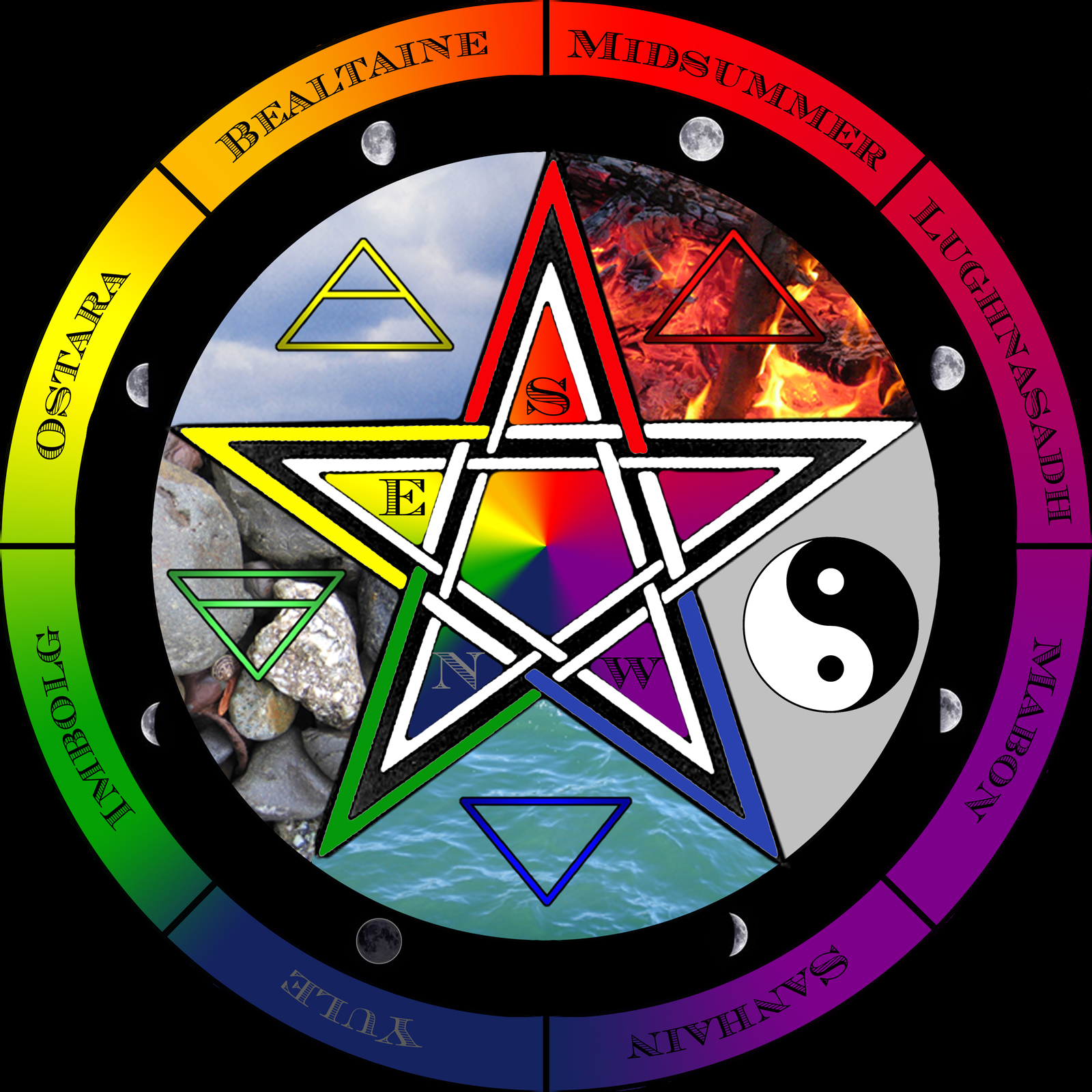
Pentacle of Balance

The Pentacle of Balance

Why Wicca? Why not choose some other spiritual path? Well for me, I love nature and the natural world. Its beauties and wonders, they all surround me and fascinate me. In other paths you need to go somewhere to be with deity. But with Wicca the gods are not only everywhere around me, but they are within me too.

I am literally the goddess and god, and these gods don’t judge me! They love me for who I am and what I already look like. I don’t need to change or alter myself to be loved, no diet or creams required. And to go with all that spiritual “yummyness,” wicca is all about nature. The thing I love most. There are the trees, the birds, the stag, the earth itself. They all represent the gods in different forms.

Also the natural world is what I live in, it is reality and I’m not trying to get to some euphoric place I’ve never experienced or been. I’m not trying to jump impossible hurtles with the rules that can never be followed without failing. All I got to do is be me.

We are rewarded with love and kindness when we give love and kindness. What we put out into the universe, the universe gives us back three fold. This cycle, among all the others is all natural. Angry vengeful God, not included! And that’s the way I like it.

Blessed be,

Moonwater Silverclaw


The Tools of Wicca: Incense

Merry meet and welcome!

We talked about salt in the last post. Now we will talk about air.

Incense

Incense

Incense represents air when burned, and is the last of the four elements represented on our altar. We burn incense in an incense burner, which we will also talk about in this post.

There are many types of incense which we will discuss in later posts. But three main forms include raw, cones, and stick incense. You have a choice of various burners, used for burning each different type of incense. Incense has these forms:

  1. Cones – You can use a specific type of burner specifically made for cones, or you can use a generic fireproof container. Fill it with sand or small stones. Such a fireproof container can be used with all types of incense.
  1. Sticks – Sticks have specific burners, usually with a hole at one end. You can slide the bare end of the stick into the hole, while the coated end remains visible. Tending to be long in shape, these burners catch the ash of the incense as the stick burns.
  1. Raw – Raw incense usually comes as a form of resin, but not always. Myrrh and Frankincense are well-known resin incense. You need charcoal to burn resin incense, and you can pick up some at your local metaphysical shop. The charcoal usually comes in a round tube shaped package. Each piece of charcoal looks like a round pad with a indent for the raw incense. Raw incense should be burned in a fireproof bowl or a cauldron. Be sure to fill the container with sand or small stones. Then place the charcoal on top of the sand and light the charcoal. Now wait until the whole charcoal piece smolders. Then carefully drop the incense on it.

Now back to air, which is a masculine element. We combine our incense with the other masculine element, fire, to create the smoke that represents air. This incense smoke is then used to charge and bless things and people. Each element on the altar proceeds to be  blessed and combined with the sibling element. Add feminine salt with feminine water. Apply masculine fire to masculine incense to create smoke. The process is you cleans with salt and water, and you charge with fire and incense. Both are utilized at the beginning of our rituals, to help clear the mundane space to make way for sacred space.

Now we’ve completed our discussion of the elements that we use on our altar. But we are not done. There are still other tools to discuss. Next will be the wand.

Blessed be,

Moonwater Silverclaw

Sabbats – Mabon

Happy Mabon!

Stop Sign

Stop and Tell Me What You Did Today!

Mabon is a time of balance between light and dark. It is the autumn equinox when the days continue to grow shorter and the dark begins to take over the light. With the nights becoming longer, the power of the God is waning.

As the second of the three harvest festivals of the year, Mabon is also known as the witches’ thanksgiving. We give thanks to the God and Goddess for all the bounty and sacrifices they have made for us. On this Sabbat we have friends and family over for a meal of thanksgiving. Foods that are in season at this time of year make great dishes for the feast. Enjoy bread, corn, squash, other autumn vegetables. Don’t forget wine, beer, and mead.

Some witches pour some blackberry wine on the ground as a sacrifice to the Gods. This ritual gives us hope of keeping the God alive until Samhain, when the God makes the willing sacrifice to keep us alive.

What did you do for Mabon this year? Share your experiences of the day with me here in the comments.

Blessed Be,

Moonwater Silverclaw

The Tools of Wicca: The Athame

Merry Meet. In my last post we discussed a little about what Wicca is. Now, lets discuss how it is practiced.

How do I practice Wicca?

We as Wiccans attune ourselves to the seasons and use the Sabbats as one of those tools to help us do so. I will be discussing the Sabbats later. I think you should know about the tools first, so let’s talk about the tools we use to help us practice the craft. We will start with the athame.

Tools

The Athame

The Athame

One of the most used tools in Wicca, the athame is a ritual dagger that we use to channel and direct energy. It is used to bless and consecrate other tools, such as the elements on our altar, which we will also discuss later.

The athame (as you can see above) usually has a black handle. It has a double edged blade. One of the most important things about the athame is that it is NOT used to cut physical objects. You never cut physical objects with it. That is what the boline is used for. We will discuss the boline later, too.

The athatme is used to channel the energy you raise to where you need it to go. This could be sending energy to bless something or in some cases even casting a circle. However some covens use the sword for that purpose. Yes, some Wiccans use a sword in their rites. The sword is just like a large athame.

The athame is generally held in your dominant hand, because, this is usually the hand most people use to “push” energy out of. So pushing the energy out and directing it with the athame is the natural next step. Each tool can either represent the masculine or the feminine. The athame is a masculine tool.

In the next post I will discuss the cup or chalice.

Blessed be

Moonwater Silverclaw

Merry Meet!

Merry meet and welcome to the Hidden Children of the Goddess blog. I am here to answer questions about Wicca that you may have and to inspire the practice of Wicca to all who are interested in the Craft. Therefore this blog is meant to educate and to inspire the student of Wicca.

I started on the path of Wicca in 1992. Slowly learning the Craft as a solitary Witch, I finally found a mentor in 2002. Now that I am a High Priestess I want to give support to those who are seeking information on Wicca.

So this blog is for the Hidden Children of the Goddess, for those who seek knowledge in the practice of honoring the gods and creating positive change in one’s life and in the world.

Blessed Be
Moonwater Silverclaw