Imagine writing down your spells so a casual observer would not be able to decipher your notes. Nowadays, someone could look up the characters, but they’d have to put some effort into it. The unusual writing form I’m talking about is the Theban Alphabet. Several years ago, when I was in college, I found the Theban Alphabet referenced in a book.
I loved the beauty of script lines. To learn this beautiful alphabet, I started writing my college lecture notes in Theban.
Where did the magickal Theban Alphabet come from? In the medieval period, magick workers wanted to disguise their notes. A number of forms of magickal writings were developed, including Theban. Then and now, alchemical and other occult traditions use Theban.
Several magick workers use Theban to keep their secrets. Only those who were initiated or taught this script could pry the magickal secrets from the pages of the writer.
Today, the Theban Alphabet is still used in paganism and especially in witchcraft.
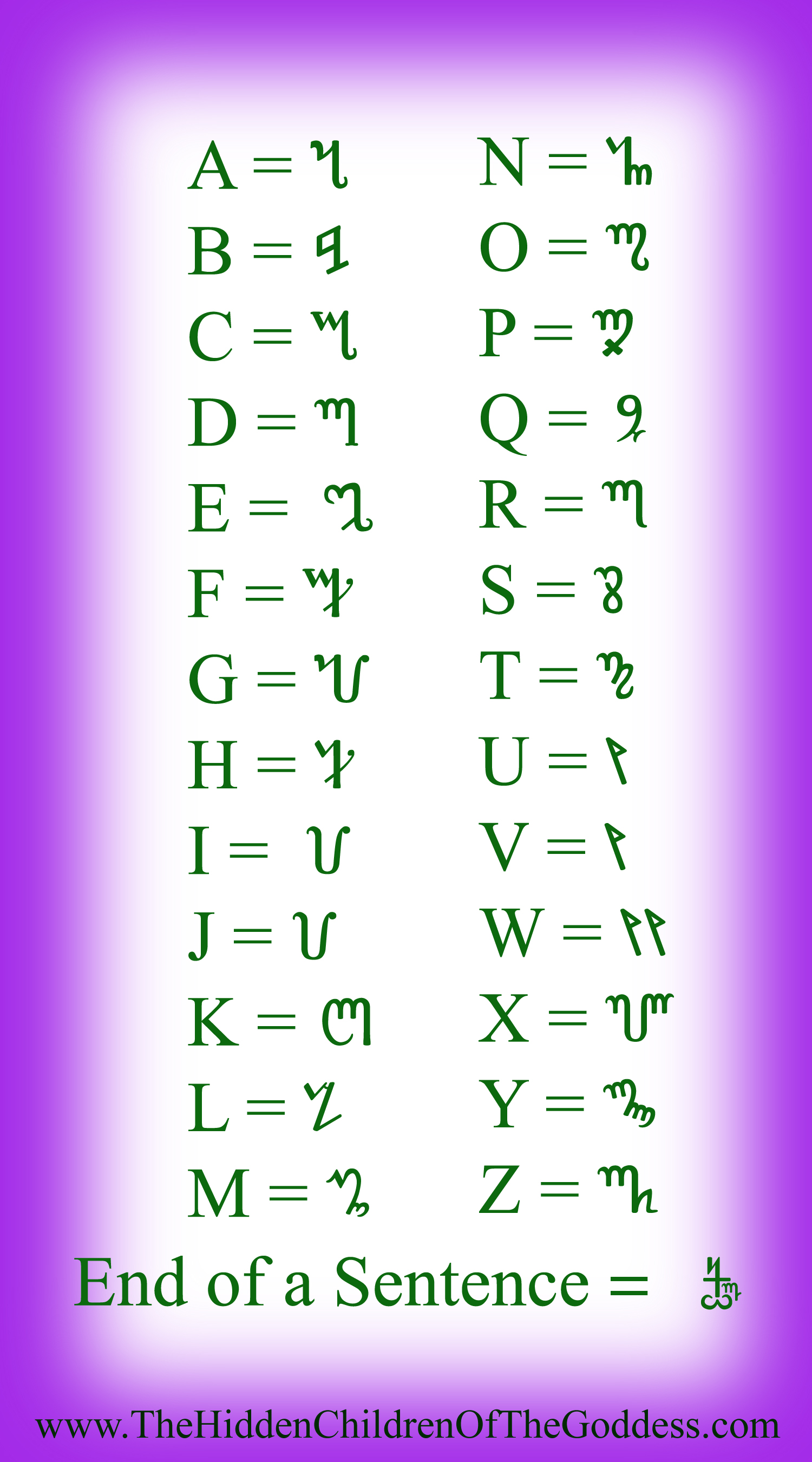
The letters in English and their equivalent Theban representatives are in the below image:
So how might you use Theban Alphabet? Consider using the script for writing in your Book of Shadows (BOS). Gerald B. Gardner wrote much of his magickal texts in Theban.
You can use Theban for talismans, carving on candles and much of the magickal work that you do.
Got a Magickal name? Use Theban to write it out. Make a personal sigil by using the Theban letters. Check out my Sigils post to know more about making Sigils.
I must say, writing in Theban can be fun.
In any case, you may want to write in some special script to elevate how you write as part of your magickal workings.
When I was initiated into the Craft, I didn’t “ground” properly after the ritual. Grounding is shunting extra energy out of your body. I failed to do the process.
Big mistake. I was up for 2 1/2 days. It was a double-edged sword: the energy was amazing, but I was bouncing off the walls. Now I was manic and tired. Headaches and body aches slammed me down.
My manic behavior annoyed the people near me. Worse yet—I put myself and others in harm’s way when I drove my car. Tired and unfocused, I was of no use to anyone.
When I finally came down from the energy, I slept for three days.
Why did I, as other Wiccans, fail to do the grounding process?
For some of us, it’s about getting distracted by the necessities of life—school, work, family responsibilities. For others, it’s because a mentor, perhaps, failed to fully train us in grounding techniques.
Many of us may do some forms of grounding but we may not fully succeed in properly moving the extra energy out of our body.
Now, I’ll share three valuable methods of grounding.
1. Eat good food.
Eat something. Carbohydrate rich foods (such as breads or pasta serve) as a good choice because they help pull you down from the high energy state that you achieved during magick working. See my Cakes and Wine Ceremony for an example of using food.
2. Push energy into the ground.
Shunt the extra energy back into the earth. One way is to take your hands or bare feet and place them on the bare earth. Release the energy by visualizing that you are pushing the energy into the earth. Mother Earth will recycle it for you. Having any contact with the earth is truly grounding. You can even lay in a field of grass and just deep breathe.
3. Hug a tree.
While hugging a tree, visualize that the extra energy is absorbed by the tree. The tree will do the rest. It naturally helps you pull the energy from your body and restore your internal balance. The tree takes the unneeded energy and shunts the energy down safely into Mother Earth.
Grounding isn’t just for after rituals. Having a tough day at work or school? Ground. Many of us make ourselves sick with built-up, unhealthy energies in our bodies. This can cause headaches and worse.
The solution is to do some grounding. You can release stress by simply deep breathing and placing your feet flat on the ground—no matter where you may be sitting.
Some Wiccans say, “But I am just doing a simple candle spell.” You still need to ground. You may not be exposed to a whole coven’s power, but you still raise energy to do any sort of magick working. This energy needs to be grounded. You may not notice the side-effects at the time, but they will still be there, and they can be harmful.
So if you have completed a ritual or you’re just feeling stressed out, ground. It not only helps you, it helps others.
One story shook me up. It was the updated results of the Doll Test. What is the Doll Test?
In the 1940’s, Drs. Kenneth and Mamie Clark gathered young children for a research study. They placed two dolls (one Caucasian and the other African-American) in front of each child. The researchers asked, “Which doll is the nicest?” [The only difference was skin color otherwise the dolls were identical.]
The startling results included African-American children choosing the white doll as “nicest.” They rejected the black doll as “bad” or “ugly.” 63% of the African-American children said that they would rather play with the white doll.
Many of us might dismiss this result as part of the “unenlightened 1940s.”
In 2009, ABC World News redid the experiment. 88% of the 19 children of color surveyed identified with the black doll.
However, still in 2009, with President Barack Obama in the White House, 47% of the black and brown girls said that the “pretty doll” was white.
This “doll test” process was repeated again in April 2014 and the brown and black girls were asked, “Which doll do you want to take home?”–and the girls got into a tug of war over a blond, white doll!
What?!
Since I’m Caucasian, I cannot know what it is like to live as a person of color. Still, I’m concerned. I believe that the Goddess comes in all shapes, shades and sizes. They are all beautiful.
For more insight, I asked my friend Crystal Blanton to share her thoughts:
“The influence of racism on black and brown people in this country does not just stop at adults, but also children who are influenced by the over culture without the adequate critical thinking skills or experience to process it. The conditioning that happens for those who are Black in this country goes back for generations, and continues to influence the way that Black culture is created, and how Black people see themselves in relation with the rest of the world. Standards of pale skin, long straight hair, and thin bodies as the definition of beauty are all around us and this influences us from the time that a child can formulate what it is to be a person. Not only is this trans-generational trauma passed on through the lineage, but we are also subjected to it within the media, and mainstream culture.
I am not sure what the Goddess would say to someone who feels less due to the color of their skin. I think this largely depends on the Goddess herself, and the depiction of the Goddess. Most of our mainstream Goddesses are also Caucasian, and do not reflect the black and brown either. If I were talking about the greater spirit of the Goddess, regardless of archetype and pantheon, I would say that she would be concerned with the implications that anyone feels inferior due to characteristics that they are born with. I also think though that she would encourage strength through the challenge and not to take that away. I believe that we, Black people, are often stronger in our resolve because of what we have walked through, and I think that is a part of the Goddess’s plan.
I don’t think that Wicca addresses racism. Some Wiccans and Pagans are doing a lot of work to bring racism into the conversation on a conscious level, so that we can use that awareness to combat it. But I think that the foundation and structure of Wicca itself was fashioned as a Eurocentric construct without the consideration that multicultural, or multifaceted individuals would be a part of this spiritual path. I think it is one of the roadblocks that we need to continue to discuss in our community as a whole.”
I agree with Crystal that having the conversation about supporting all of us—all of us beautiful people with various colors, sizes and characteristics—is important.
Frequently, in current news, there is a group of people who say that we are in a “post-racial” world in the United States. (By the way, those voicing the opinion are NOT people of color.) They imply that no consideration be shown for people dealing with inequities due to color and ethnicity.
However, when I talk with my friends and my sweetheart (who is a person of color), they say that they have all experienced different treatment due to their skin color. They disagree strongly that the United States is “completely enlightened” at this time.
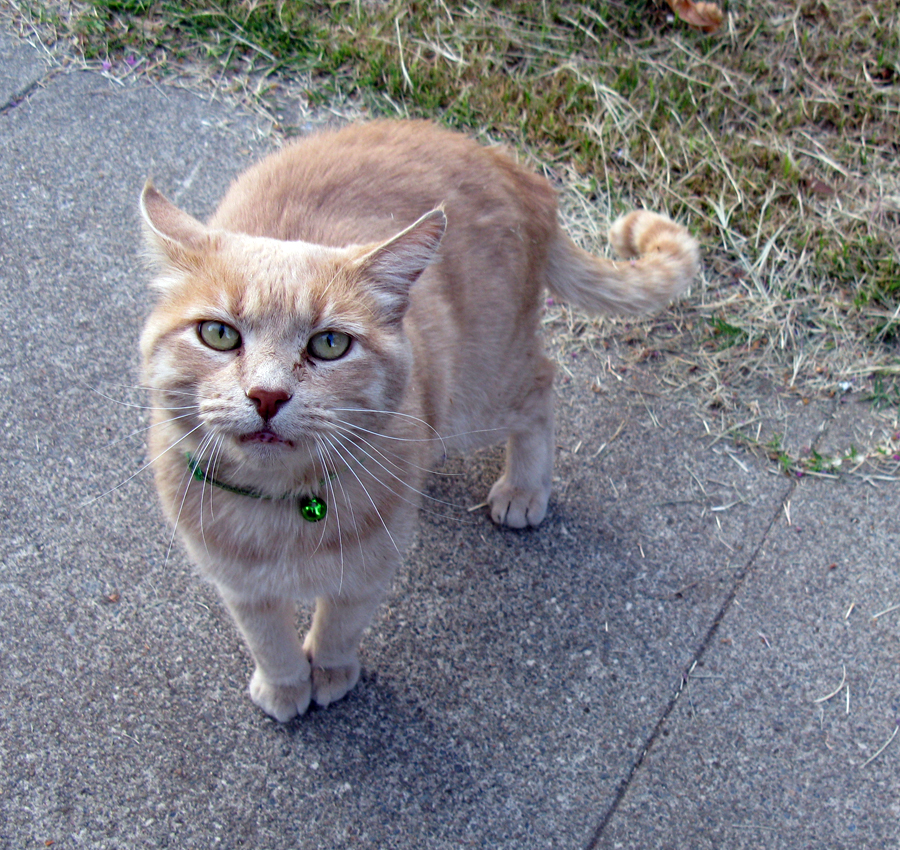
Cleo, my cat, looked up at me. At 14 years old, Cleo needed me to give her intravenous fluids to sustain her. One night while I was administering her daily fluids she simply looked into my eyes and told me, I’ve had enough, I’m done.
I just knew. Other times, I’ve wrestled with the decision of when it was time to let go of my beloved pet.
Now, I’ve had cats my whole life. In high school, I was introduced to domesticated, pet rats. These little furry friends have terribly short life spans. I’d have four at the same time, and this meant crying every year as one of them would become ill due to old age. I had many times to practice letting go.
I have spent thousands of dollars for medical care for my fuzzy babies. But how does one know when to let go?
If a pet or familiar is close to crossing the veil, when is it truly time to let go?
First listen to your little friend. Here are some signs to help you consider when to let go.
• Is your furry companion still interested in life?
• Does your companion still enjoy eating?
• Does he/she still play in spite of the illness or disease?
• Is the little one in tremendous pain that prevents him/her from being happy?
Now I’m not talking about temporary illness. This is about the end of a life—a terminal illness.
Recently, on Facebook, people discussed the condition of Blacky, The Wheelchair Cat.
A native of New Zealand, he has one eye, and after being struck by a car, he’s left with spinal nerve damage and paralysis in his rear legs and bladder.
A number of people suggested that Blacky be “put down.”
But wait a moment! Blacky can now feel his legs if one tickles them. Sometimes he moves or stands on them. Last year, he had a perianal urethrostomy surgery because of his bladder problems.
Still, Blacky enjoys life. He enjoys going outside and playing. Other than his mobility issue, Blacky’s now healthy.
In summary, I invite you to look at my list and let it help you make a good decision about whether it may be time to let a pet go.
Sure, sometimes our pets have physical troubles. But you’ve probably noticed the we, humans, can have physical troubles, too. Still, we find ways to have joy and meaning.
Let’s make sure to support our furry friends in their times of need.
Would you benefit from studying with an online Wicca or Pagan school? To explore this topic, I interviewed Heather Greene, Luna Marr, and Aline O’Brien.
(Some responses may have been edited for length.)
Let’s start.
* When should someone consider going to an online school?
Luna: When it’s necessary. Some students work out very well with books and doing their own research, but there are others . . . who feel they need to hide their beliefs and study in secret, or just live in areas where a one-on-one pagan education isn’t available. Not all online educations are equal. . . . Some online schools just charge you money, hand you a bunch of information with little to no guidance. And others give you a mentor experience [in] your own home via the Internet.
Aline O’Brien: In the case of Cherry Hill Seminary (CHS), because there is no other school offering full training parallel with what is taught at mainstream seminaries. I strongly feel that Pagans should collaborate on the creation of our own culture. That means not attending liberal Protestant seminaries because you think they’re the only game in town when it comes to seminary-type training (chaplaincy, pastoral counseling, interfaith, history, etc.)
Heather: Online schools can help people who, for one reason or another, don’t have the ability to physically attend classes. In addition schools like Cherry Hill Seminary offer access to subjects and teachers that might not be available locally.
Moonwater: I agree. Online education may be necessary for someone who does not have a local pagan community for support.
* Would you use an online choice for your primary way of learning Wicca verses face-to-face learning?
Aline: Not necessarily. It really depends a lot on what’s available in a particular individual’s area.
Heather: I would not choose distance learning as my primary way of learning any subject unless no other option was available. And there are situations where that is the case. I do prefer the immediacy of presence and the concentrated, shared energy of the “classroom” experience. This cannot be replicated online. However I also believe that there are educational opportunities in all forms of learning processes. Distance learning gives us access to teachers and professional who might otherwise not be available to us at any point in our lives. I see that alone as an invaluable resource.
Luna: I wouldn’t say that I would choose it over face-to-face learning, simply that it’s an alternative and another valuable option. . . . In my school Pagans Learning Online we believe that an online education should mimic the face-to-face experience as closely as possible, through technology such as Skype, Google, and the ability to upload voice, video, and written materials. We are able to replicate the face-to-face experience fairly well. Is it the same as having that mentor there who can give you a hug when you’re down? Absolutely not. However, an online education can still offer the same benefits.
Moonwater: I prefer the face-to-face approach when possible. This way you can experience how your student moves and uses energy. However, it’s important to me that students have access to information. That’s the reason that I write this blog (with the help of my editors) and I wrote my book The Hidden Children of the Goddess.
* Are online schools helpful or harmful to our community?
Luna: This question is like a double edged sword. I want to say that online schools can be incredibly helpful to the Pagan and Wiccan community . . . . [But] some schools offer a lot of false certifications and dangerous ideas that if a person was so willing they could take advantage of. I even heard of one online school that tells you that you’re not allowed to worship the Gods and Goddesses unless you are a Level 1 priestess and [have] passed their tests. A student looking into an online school needs to know when something just doesn’t sound right or seem right. They need to do their research. . . . Healing of the aura and the chakras is something that should be left up to trained professionals. . . . For people who are forced to practice in the shadows, having the opportunity to practice online is something that [can] change who they are in a positive way. Online schools have the ability to help guide and grow future leaders of the Pagan and Wiccan community so that the next batch of people who look for a place to learn may not have the same struggles.
Aline: Some are helpful, others not so much; depends upon the school. I can say, however, that Pagans attend CHS for two primary reasons: one is for personal enrichment and the other to better serve their own communities. They don’t come so they can get a degree and get a job by being hired by some Pagan ‘church.’ They don’t come so they can get a raise at their current job. In the bigger picture, some seek chaplaincy degrees because in the mainstream world having one is required in order for one to do that work (the military being the most stringent in terms of chaplaincy requirements).
Heather: Just like anything, distance learning can be both helpful and harmful. It is helpful for the reasons specified above. Distance learning can offer people an opportunity to attend classes that they might not be able to otherwise. At the same time, distance learning is not yet accredited in the same way as conventional institutions. Assessing a school’s credibility and legitimacy is left to student and [it’s] often very difficult. The digital world has created a universe in which legitimacy is easier to falsify. Students must be very cautious.
* Online schools are on the rise, so how can you tell if one is right for your student?
Luna: It’s about doing the research, knowing yourself and your own personal learning style, and using your common sense. . . . Paganism and Wicca are terms for thousands of proud and dedicated religious pathways and traditions, rooted 60,000 years in the past. That isn’t easy stuff to learn over night. I think that as a society we get far too wrapped up in the “I want it now” of things and we overlook the hard work and dedication it takes to do something right. So before you jump into the first online school of Paganism that you see, do some research and ask some questions and remember that if it doesn’t look right or sound right then keep looking.
Heather: It is important to research the institution, teachers and the administrative staff; to examine the promises made and the cost; to talk to former students and to ask as many questions as possible.
Aline: I would say in the same way one would explore schools for any other kind of learning–read everything possible, ask others who attended that school, etc. I’m not sure I quite ‘get’ telling what’s right for one’s student. To me, the student her/himself would be the person making such decisions. S/he could seek advice and recommendations from a teacher. Alternatively, a particular teacher may wish to direct a particular student to a specific online educational resource/school for, say, a course on ministering to the dying.
* When should you not consider a school as a supplement for your student?
Heather: If local resources and lifestyle permit, it is good to consider the local options first. I would also steer a student away from a school that does not “check out” as legitimate.
Aline: Again, I can’t really speak knowledgeably to this because my experience is with a graduate school. It’s not about learning Wicca per se.
Luna: The only answer I would have for this is when the reason for seeking out the education isn’t pure of intent. . . . However if what you’re looking for is a chance to grow both as a person and in your magical abilities and you embrace the dedication it takes, then online schools are a great choice. I have seen many students whose self-esteem has bloomed. [And, one’s] inner light and love of yourself and those around you [become] powerful tools to change the world.
Since, Luna and Aline are active with online schools, I asked this question:
What can web schools like yours offer students with mentors?
Luna: I suggest a student stay with their mentor . . . unless they aren’t getting a full education from their mentor. I have had very good mentors. My first mentor was a Wiccan High Priestess. I myself have chosen the path of druidry, but it was very nice and refreshing to be able to learn so much about the Wiccan beliefs and practices. [I enjoyed] spending time with someone who knew what I was going through at a young age and was able to help guide me. It was a valuable experience. However, she was only able to offer me part of the picture that I was looking for. She could only teach me about Wicca. Because of this, I found myself studying books for years, doing research and seeking out others who had other beliefs.
Aline: The online school with which I’m affiliated, Cherry Hill Seminary (www.cherryhillseminary.org), provides primarily graduate-level education. We offer two masters’ degrees–M.A. in Pagan Studies and M.Div. So CHS is different from other online Pagan schools in that our students are already whatever kind of educated Pagan they are. In other words, mentors aren’t in the picture. Those who are seeking degrees, which is not all of our students, must attend two live, in-person multi-day retreats during the course of their studies. (http://www.cherryhillseminary.org/) CHS has a Dean of Students, who is not exactly a mentor but does help students determine their personal course of study. I think (not entirely sure) students have faculty advisors when they choose a degree path. (There’s tons of detailed info on this topic in CHS’ Catalogue.)
Some Pagans view Online Wiccan education as a controversial topic. The views expressed above belong to those who expressed them.
I, Moonwater, prefer the one-to-one mentor/student process (and that is my training). However, it strikes me that it is helpful to carefully study material if a local Pagan community is not available.
As with other important decisions, devote great care to your educational path.
Biographies of Our Interviewees
Luna Marr, has been studying paganism both independently and with various mentors for the last 21 years. She is very proactive in her local pagan community, serving as both clergy and secretary in her local pagan church. She says, “I have always believed that paganism deserves the same respect as other religions, but with that respect comes responsibilities to be knowledgeable in your beliefs and in the history of your beliefs. I feel that with the growing interest in paganism there need to be more hands-on ways for people to learn and grow without the pressure of being forced down one pathway or another.” Email: Luna@paganslearningonline.org Her online school is Pagans Learning On Line.
Do you travel a lot? Have you missed viewing your Gods from your home altar? Make a Portable Shrine. It’s fun.
The Mobile Shrine Closed
What you will need:
One wooden hinged box
Different colored tissue paper (I used some paper with a flower-pattern for one of my boxes.)
Image of the God
Image of the Goddess
Glue gun and glue
Tulip® Dimensional Fabric Paint–Glitter
Mini flowers and/or other decorations for the Gods
(For example, I included flowers for the Goddess. You can use beads,
paint, coins or other decorations that have meaning for you and your
Gods.)
Electric tea lights. Hotels do not let you use lit candles.
Mod Podge glue
Sponge applicator (for the glue)
Other decorations like stickers and such as desired
To start, I applied Mod Podge glue to the exterior surface of my wooden box. Then I affixed the flower-patterned tissue paper to the surface with the glue. Note in the photo how the patterned tissue paper provides an interesting texture. (Be careful and use glue on only one side at a time. Let the glue fully dry.)
Then I applied another coat of glue over the tissue paper to seal it.
As another option, you can paint your box any color that seems appropriate, perhaps, your favorite color.
Although you could add decorations to the outside of the box, I suggest leaving it plain. Why? You do not want a hotel maid or other stranger to be drawn to the box out of curiosity.
Inside the box, I used red tissue paper. Pick the color you prefer. Whether you glued paper or painted the inside, wait for it to dry. Then use glue to apply the images of your chosen God and Goddess.
Note in the photo that I used Tulip® Dimensional Fabric Paint–Glitter to cover the edges of the Deities’ pictures—gold glitter for the God and silver for the Goddess.
I added pearl 3D-stick-ons and other jeweled stick-on pieces to accent my images. I also added glittery stickers on the sides to personalize the interior of my box.
I strung beads in strands—two for the God and one long strand for the Goddess. I used fishing line for that. I draped the beads and used the glue gun to affix the ends in place.
As a finishing touch, I employed the glue gun as I added mini-flowers to the Goddess’ side.
Once your Portable Shrine is fully dried, you close it up. From the outside, no one will know what it is.
Take your Portable Shrine anywhere, open it up and place the electric candle in front to honor the God and Goddess.
My Portable Shrine is small and compact enough to fit into a backpack that I bring on a plane. I even took it on a cruise. It’s nice to have the familiar company of my shrine when I am away from home.
At home, I place my Portable Shrine in a prominent location and enjoy it.
Since, when closed, your Portable Shrine is nondescript, it can be placed on a book shelf or the corner of a desk. Some people consider using a Portable Shrine in a dorm room because the Portable Shrine can be closed quickly.
Making a Portable Shrine can be a fun family project. You could have each family member contribute to one Family Portable Shrine or each person could create his or her own. Perhaps, you might want to do both. They are fun and relatively easy to make.
So keep the craft in witchcraft and have some fun while honoring the Gods.
Security—what is it? Is it a home, a job, or family? If that’s security, what if these things are taken away? What then?
My friend Bob lives with his parents. He is disabled and so he can’t manage to live on his own. He also needs the support of his family to help him with day to day activities such as cooking and cleaning. To him, his living situation with his family is a place of security. However, last week he was told by his father that he had to move out. This pulled the rug of security right out from under him.
Bob was terrified.
Here’s another example: Janet has to keep her Wiccan faith a secret from her family who subscribe to another religion. One day, at a family gathering her pentacle pendent fell out of her blouse. Aghast, her mother called her father and together they yelled and drove her from the gathering. Her parents and other relatives disowned her. That was their word, disowned.
Now, Janet cries–at different times during the day. Sometimes, she flees to the restroom, when she’s at work. She used to believe that her family was her bedrock. No more.
What happens when our sense of security is taken? Where do we go? Did we really lose security?
I say security isn’t a place. It’s not a thing, and it’s not a family tie. The truth is: Things change. We can’t rely on these things for our security.
So where is security found?
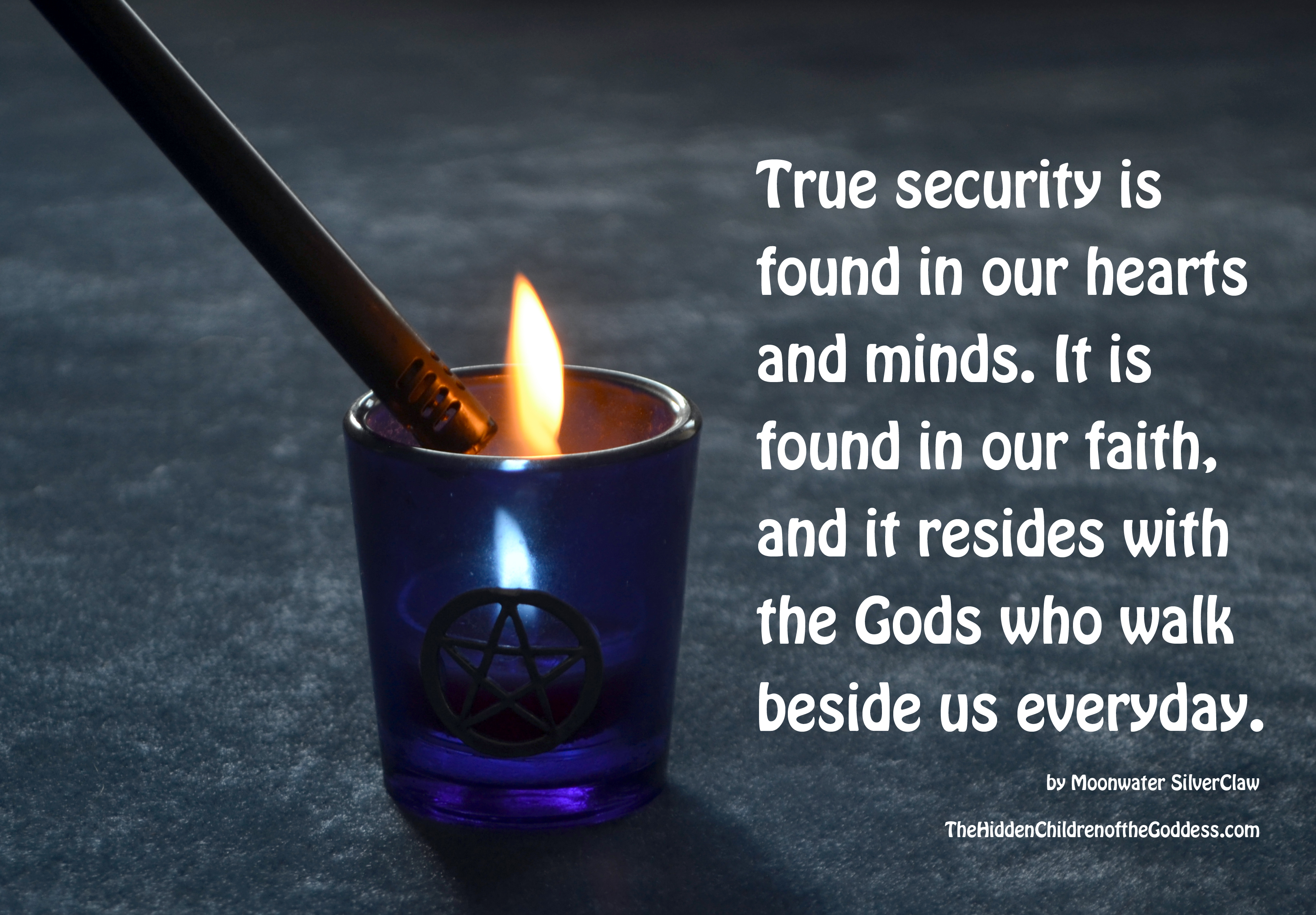
True security is found in our hearts and minds. It is found in our faith, and it resides with the Gods who walk beside us everyday.
The Gods do not waver. They are constant, eternal, all encompassing.
So let’s face it. Security is not in the material. True security is in the spirit.
You can call on your true security anytime and anyplace. The great thing about being Wiccan is that you can create your temple anywhere by casting your circle.
More than that, you can recite a blessing in your own thoughts.
Here is a blessing that you can recite to yourself:
Patti Wigington defines a “Fluffy Bunny” as: “In general, ‘fluffy bunny,’ or ‘fluffbunny,’ is a derogatory term used to apply to members of the Pagan community who (1) insist that they know everything they need to know, (2) often make blanket statements about what ‘real Pagans’ do and don’t do, and (3) flat-out refuse to acknowledge that people who think differently from them can be Pagan, too.”
If someone thinks they know everything they need to know, they can make serious mistakes. Such arrogance can lead to physical danger. For example, I once read a book that talked about grinding certain stones, putting them in water and drinking the water. Do NOT do this! The rocks may contain traces of harmful compounds like arsenic or other poisonous substances.
Further, grinding stones with a high silicon composition is like grinding up glass. Drinking such a solution will turn your insides into hamburger. Again, don’t do it!
Watch out about herbs, too. Avoid just taking the advice of one book. Check in with an elder or mentor (or two or three). Do NOT experiment on yourself!
By definition, Fluffy Bunnies aren’t doing research. They can fall into believing mixed up notions. For example, Wicca is NOT the TV show Charmed.
The truth is: Wicca and Paganism have a real history throughout time. It’s valuable to study such history and avoid being misguided by something created merely for entertainment. I have heard a number of people saying that Fluffy Bunnies have a bad reputation for talking about things in an “everything is butterflies and unicorns” manner.
Fluffy Bunnies, as Patti noted, often make blanket statements about what “real Pagans” do and don’t do.
I note that sometimes Wicca and Paganism appear like herding cats. Everyone has their own ideas of what is the right way. I am Gardnerian, a British tradition. Does that make someone in the Feri tradition wrong? No.
Here’s a way to view the situation. Let’s say you have a potato. Every tradition cooks the potato differently. One may dice the potato, fry it and enjoy fries. Others mash the potato. Still, others may bake the potato and leave it whole. Does this mean that one is better than the others? No. The people all cooked the potato.
The outcome was the same, just the preparation was different.
Now, one might say that Fluffy Bunnies are merely cooking the potato in their own way. Fair enough. However, with this article, I’ve pointed out some details that we, as Wiccans, need to view with great care.
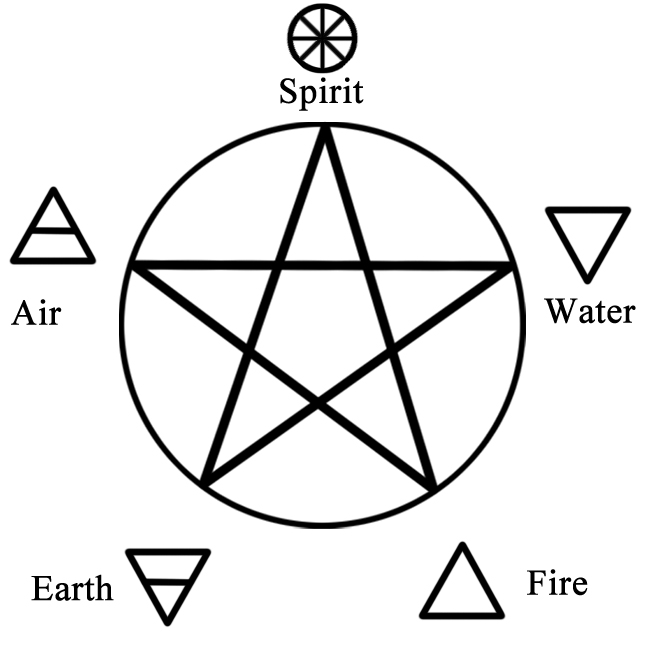
When we begin a ritual and call in the Elements, we are inviting them to protect us and help us with something we want in life.
For example, if I’m doing a ritual related to love, I may invoke Water because it focuses on emotions.
I may want to bring passion to some situation in my life, and I would then invoke Fire.
How do we invoke an Element? It involves moving your hand in the air according to that which is indicated in the below diagram.
Proper invoking is easy. All you need to know is where to start. Here is a good rule: To invoke, go towards the element you’re invoking.
What this means is: you move your hand in the air (according to the diagram) in the direction of the desired Element.
At the end of your ritual . . .
At the end of the ritual, you will want to banish the element. I’ve shared with a student that if you don’t banish Water after you invoke it, you might end up with plumbing problems. If you don’t banish Fire, you might have a fire start in your home. Don’t let this happen! Be sure to banish the element.
To banish the element, move your hand in the direction away from that element you wish to banish. You can see this in the diagram below.
When do I use the elemental invoking and banishing pentacles? One of the most common ways to use these pentagrams is casting and later taking down a circle. The other most common use is when you work with specific elements.
Elements can be a powerful part of your spiritual practice.









 GoddessHasYourBack.com